Hair Transplant Scars – What You Should Know Before and After Surgery
By Dr Manoj Khanna
Board-Certified Plastic Surgeon | 30+ Years of Experience
Introduction
One of the most common concerns I hear from patients considering a hair transplant is:
“Will it leave a visible scar?”
It’s a valid question—and an important one.
The truth is, every surgical procedure leaves some form of scarring, and hair transplantation is no exception. However, with modern techniques and proper surgical planning, these scars are usually minimal, well-concealed, and often virtually undetectable.
In my practice, I focus not only on restoring hair but also on preserving the integrity and appearance of the donor area, ensuring that any scarring remains as inconspicuous as possible.
Understanding the nature of hair transplant scars will help you make a more informed and confident decision.
Do Hair Transplants Leave Scars?
Yes, hair transplants do leave scars—but the key question is not whether scars occur, but how noticeable they are.
In most cases, scars are:
- Extremely small
- Strategically placed
- Hidden within existing hair
The visibility of a scar depends on several factors, including:
- The technique used (FUE or FUT)
- The skill and experience of the surgeon
- Your individual healing characteristics
- How well are post-operative care instructions followed
When performed correctly, a hair transplant should not leave behind anything that draws attention or affects your appearance.
Types of Hair Transplant Scars
Different hair transplant techniques result in different types of scars. Understanding these differences is essential when choosing the right procedure for your needs.
FUE (Follicular Unit Extraction) Scars
FUE is one of the most commonly performed hair transplant techniques today.
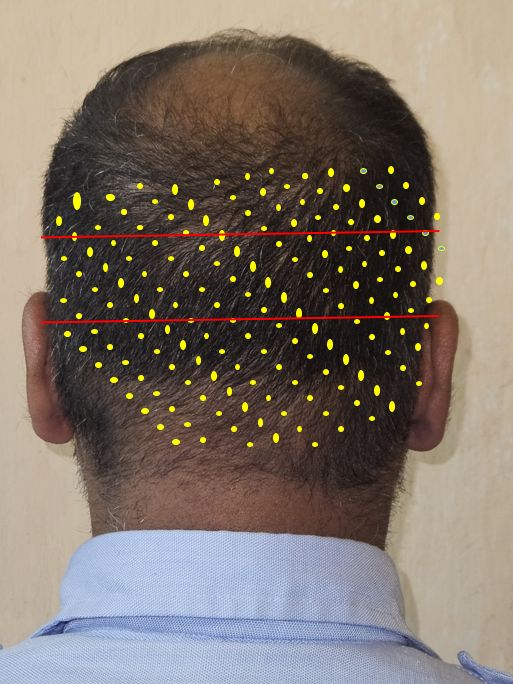
In this method, individual hair follicles are extracted from the donor area using specialised micro-punch tools. This process creates:
- Tiny, circular, dot-like scars
- Spread evenly across the donor region
These scars are:
- Typically less than 1 mm in size
- Barely visible once healing is complete
- Easily concealed even with short hair
However, if the donor area is overharvested or improperly handled, these tiny scars can become more noticeable. This is why precision and planning are critical.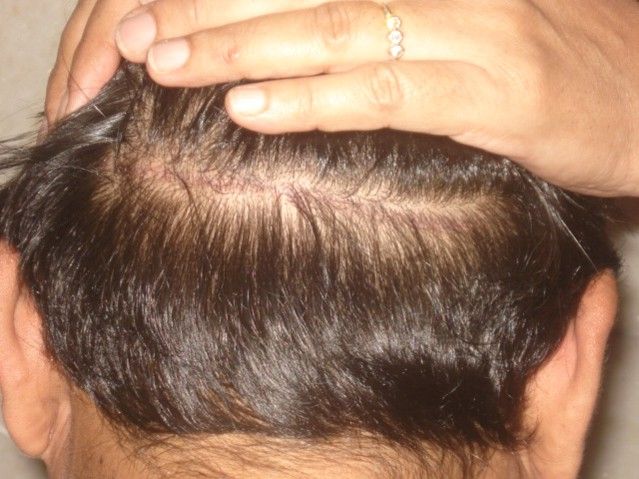
FUT (Strip Method) Scar
In the FUT (Follicular Unit Transplantation) technique, a thin strip of scalp is removed from the donor area, and the wound is then closed with sutures.
This results in:
- A single linear scar at the back of the scalp
The scar:
- Is usually hidden under surrounding hair
- Can be very fine when closed properly
- May widen if healing is poor or under tension
While FUT may leave a more defined scar compared to FUE, it is still a suitable option for patients who:
- Require a large number of grafts
- Prefer to keep longer hair
Scars from Beard or Body Hair Transplant
In certain cases, beard or body hair is used as an additional donor source.
These procedures also use FUE-based extraction and result in:
- Small dot scars similar to scalp FUE
In the beard area, scarring is typically:
- Minimal
- Well hidden within natural hair patterns
Careful technique is especially important in visible areas like the face to ensure optimal cosmetic outcomes.
What Determines How Visible Your Scar Will Be?
Not all scars are the same. Two patients undergoing the same procedure can have very different outcomes.
Here are the most important factors that influence scar visibility:
1. Surgeon’s Skill and Experience
This is the single most important factor.
Precise extraction, proper angulation, controlled depth, and careful handling of the donor area significantly reduce scarring. Poor technique, on the other hand, can lead to:
- Overharvesting
- Patchy donor areas
- Noticeable scarring
2. Technique and Tools Used
Advanced tools and refined techniques allow for:
- Smaller incisions
- Faster healing
- Better cosmetic results
For example, micro-punch FUE tools minimise tissue damage and reduce scar size.
3. Donor Area Density
Patients with higher donor density tend to heal better visually because:
- Remaining hair helps conceal extraction sites
Lower density can make scars slightly more noticeable if not managed properly.
4. Skin Type and Healing Tendency
Every individual heals differently.
Some patients may be prone to:
- Hypertrophic scars
- Keloid formation (rare but important to consider)
Proper pre-surgical assessment helps identify these risks.
5. Post-Operative Care
Even the best surgical work can be compromised without proper aftercare.
Following instructions such as:
- Avoiding scratching or picking
- Maintaining hygiene
- Attending follow-ups
…plays a major role in how well scars heal.
6. Extent of Graft Extraction
Excessive graft harvesting in a single session can:
- Overstress the donor area
- Increase scar visibility
A well-planned, staged approach often produces better long-term results.
Hair Transplant Scar Healing Timeline
Healing is a gradual process, and understanding the timeline helps set realistic expectations.
Day 1–7: Initial Healing Phase
- Redness and mild swelling
- Formation of small scabs
- Donor area may feel tight or sensitive
Week 2–4: Recovery Phase
- Scabs begin to fall off naturally
- Skin starts regenerating
- Visible signs of healing improve
1–3 Months: Scar Maturation Begins
- Redness fades
- Scars become less noticeable
- Hair growth continues in both donor and recipient areas
6–12 Months: Final Appearance
- Scars fully mature
- Blend seamlessly with the surrounding skin
- Usually difficult to detect, even on close inspection
Can Hair Transplant Scars Be Prevented?
This is an important point to understand clearly.
Hair transplant scars cannot be completely prevented because any procedure involving the skin will leave some degree of scarring. However, they can be minimised to the point of being practically invisible.
In my practice, the goal is always:
- To reduce tissue trauma
- To preserve donor area density
- To ensure scars remain undetectable under normal conditions
The key lies in making the right choices from the beginning.
Choosing the Right Technique
Not every patient is suited for the same technique. While FUE generally results in less noticeable scarring, FUT may still be the better option in certain cases.
A personalised assessment ensures:
- Optimal graft yield
- Minimal donor damage
- Better long-term aesthetics
Selecting an Experienced Surgeon
Hair transplantation is as much an art as it is a science.
Proper angle, depth, spacing, and distribution of grafts directly influence how the donor area heals. Inexperienced handling can lead to:
- Overharvesting
- Uneven density
- Visible scarring
Following Post-Operative Instructions
Your role as a patient is equally important.
Simple precautions such as:
- Avoiding trauma to the donor area
- Using prescribed medications
- Attending follow-ups
…can significantly improve healing and scar quality.
How to Reduce or Treat Hair Transplant Scars
Even in cases where scars are noticeable, there are multiple ways to improve their appearance.
Medical Treatments
PRP (Platelet-Rich Plasma) Therapy
PRP uses your body’s own growth factors to:
- Accelerate healing
- Improve skin quality
- Reduce scar visibility
It is often used as an adjunct after surgery.
Microneedling
Microneedling stimulates collagen production and helps:
- Soften scar tissue
- Improve skin texture
- Blend scars with the surrounding areas
Concerned about visible scars after a hair transplant?
Book a personalised consultation with Dr Manoj Khanna to understand the safest technique for your hair type and goals.
Surgical Solutions
Scar Revision Surgery
In cases of widened or poorly healed scars (especially after FUT), revision surgery can:
- Reduce scar width
- Improve overall appearance
Hair Transplant into Scar Tissue
Hair follicles can be implanted directly into the scar to:
- Camouflage the area
- Restore a natural look
This is particularly effective for linear scars.
Cosmetic Solutions
Scalp Micropigmentation (SMP)
SMP is a non-surgical technique that:
- Uses pigment to mimic hair follicles
- Reduces contrast between scar and skin
Hairstyling Adjustments
Simple changes in hair length and style can:
- Effectively conceal scars
- Enhance overall appearance
FUE vs FUT – Which Leaves Less Scarring?
This is one of the most frequently asked questions.
FUE is often described as “scarless,” but that is not entirely accurate. It leaves multiple tiny scars, while FUT leaves a single linear scar.
The real difference lies in:
- Distribution vs concentration of scarring
- Visibility based on hairstyle preferences
FUE
- Minimal, scattered scars
- Ideal for shorter hairstyles
FUT
- Single linear scar
- Better suited for patients keeping longer hair
In my approach, the choice is never based on trends but on:
- Your hair characteristics
- Donor area condition
- Long-term planning
Common Myths About Hair Transplant Scars
There is a lot of misinformation surrounding this topic. Let’s address some of the most common myths.
Myth 1: FUE is completely scar-free
No surgical method is scar-free. FUE scars are simply less noticeable.
Myth 2: Hair transplant scars are always visible
When performed correctly, scars are usually hidden within existing hair and are difficult to detect.
Myth 3: Hair transplants permanently damage the donor area
A well-planned procedure preserves donor density and maintains a natural appearance.
Myth 4: Once a scar forms, nothing can be done
Modern treatments and techniques can significantly improve scar appearance.
When Should You Be Concerned About a Scar?
While most scars heal normally, certain signs should not be ignored.
You should consult your surgeon if you notice:
- Excessive redness or swelling
- Persistent pain
- Signs of infection
- Raised or thickened scars
- Unusual widening of a linear scar
Early intervention can prevent long-term issues.
Planning a hair transplant but worried about scars?
Let me guide you with a customised treatment plan designed for natural results and minimal scarring.
Schedule your consultation today.
Why Choose Dr Manoj Khanna for Hair Transplant Surgery
Over the years, I have treated patients with diverse hair loss patterns and expectations.
My focus remains on:
- Natural-looking results
- Minimal donor area trauma
- Long-term planning, not short-term fixes
Each procedure is carefully designed to:
- Preserve donor area integrity
- Ensure balanced graft extraction
- Achieve results that age naturally
Conclusion
Hair transplant scars are a natural part of the procedure—but they should never be a source of concern when the surgery is performed correctly.
With the right technique, proper planning, and expert execution, scars can be:
- Minimal
- Well-concealed
- Virtually unnoticeable
If you are considering a hair transplant, the most important decision you will make is choosing the right surgeon.
About Dr Manoj Khanna
Dr Manoj Khanna is a board-certified plastic surgeon with over 30 years of experience in cosmetic, reconstructive, hair transplant, face, body, and breast surgery. He is known for his patient-centric approach, natural-looking results, and advanced surgical expertise.
Dr Khanna has treated patients from India and across the world, with a focus on safety, aesthetics, and personalised treatment planning.
Contact Details
Book Consultation: +91 98300 85506
Clinic Address: Enhance Aesthetic and Cosmetic Studio, 12 Loudon Street, Flat 5A, Kolkata, West Bengal 700017, Opposite Bellevue Clinic
Website: www.plasticsurgery-india.com
FAQs
- Are hair transplant scars permanent?
Yes, scars are permanent, but they usually fade and become barely visible over time.
- Can I shave my head after a hair transplant?
After FUE, shaving is usually possible without noticeable scarring. After FUT, a linear scar may be visible with very short hair.
- Which technique leaves the least visible scars?
FUE generally results in less noticeable scarring, especially for patients who prefer short hairstyles.
- Can hair grow over transplant scars?
Yes, hair can be transplanted into scar tissue to improve its appearance.
- How long does it take for scars to heal completely?
Most scars mature and become less noticeable within 6 to 12 months.
- What happens if the donor area is overharvested?
Overharvesting can lead to visible thinning and a patchy appearance in the donor area.
- Are hair transplant scars painful?
Scars are usually not painful once healing is complete.
- Can PRP help reduce scars?
Yes, PRP can improve healing and reduce the appearance of scars.
- Is FUT scar always visible?
No, it is usually hidden under surrounding hair unless the hair is cut very short.
- Can scars worsen over time?
In rare cases, scars may widen or become more noticeable, especially without proper care.
- What is the best way to avoid visible scars?
Choosing an experienced surgeon and following post-operative care instructions are the most effective ways.
- Can scalp micropigmentation completely hide scars?
It can significantly reduce visibility, especially for FUE scars or thin FUT scars.
Enhance Aesthetic & Cosmetic Studio
12, Loudon Street Kolkata - 700 017, India
Monday to Saturday at - 10am to 7pm (By appointment)
+91-33-22829126 / 22828500
+91 98300 85506
drmkhanna@gmail.com
Celebrities with Dr Manoj Khanna
• Arun Lal, Cricket Player
• Dilip Vengsarkar, Cricket Player
• Brijesh Patel, Cricket Player
• Roger Binny, Cricket Player
• Govinda, Actor
• Mimoh Chakrabarty, Actor
• Arjun Chakrabarty, Actor
• Nikhil Chopra, Cricket Player
• Charu Sharma, Cricket Player
• Rituparna Sengupta, Actor
• Lalchand Rajput, Cricket Player
• Brijesh Patel, Cricket Player