
Hair loss affects both appearance and confidence. Over the years, I have seen a growing number of patients in India opting for FUE Hair Transplant because it offers natural-looking results with minimal visible scarring.
FUE (Follicular Unit Extraction) is one of the most advanced hair transplant techniques available today. In this blog, I will explain how the procedure works, who is suitable for it, recovery expectations, and important factors patients should know before undergoing surgery.
What is FUE Hair Transplant?
FUE Hair Transplant is a procedure in which individual hair follicles are extracted from the donor area and implanted into bald or thinning regions of the scalp.
Unlike strip methods, FUE does not involve removing a strip of skin. Instead, grafts are extracted individually using specialised instruments.
Key Features of FUE
- Minimally invasive procedure
- No long linear scar
- Natural-looking hairline
- Faster healing in most patients
- Suitable for short hairstyles
- Can also be used for beard and eyebrow transplant
Why FUE Hair Transplant is Popular in India
FUE hair transplant has become increasingly popular due to better awareness, improved techniques, and affordable treatment options.
| Reasons for Popularity | Benefits |
| Advanced technology | Better graft survival |
| Minimal scarring | Short hairstyle friendly |
| Faster recovery | Less downtime |
| Natural results | Improved confidence |
| Affordable treatment in India | Cost-effective compared to many countries |
Who is an ideal candidate for a FUE hair transplant?
Not everyone experiencing hair loss is suitable for surgery. Proper evaluation is extremely important before planning treatment.
FUE May Be Suitable For:
- Men with male pattern baldness
- Women with localised hair thinning
- Patients with a healthy donor area
- Individuals wanting minimal visible scarring
- Beard transplant patients
- Eyebrow transplant patients
- Corrective hair transplant cases
Important Factors I Evaluate
- Hair loss pattern
- Donor area density
- Scalp condition
- Age and medical history
- Future progression of baldness
- Patient expectations
How I Perform FUE Hair Transplant Surgery
Every patient requires an individualised treatment plan. My focus is always on creating natural and long-lasting results.
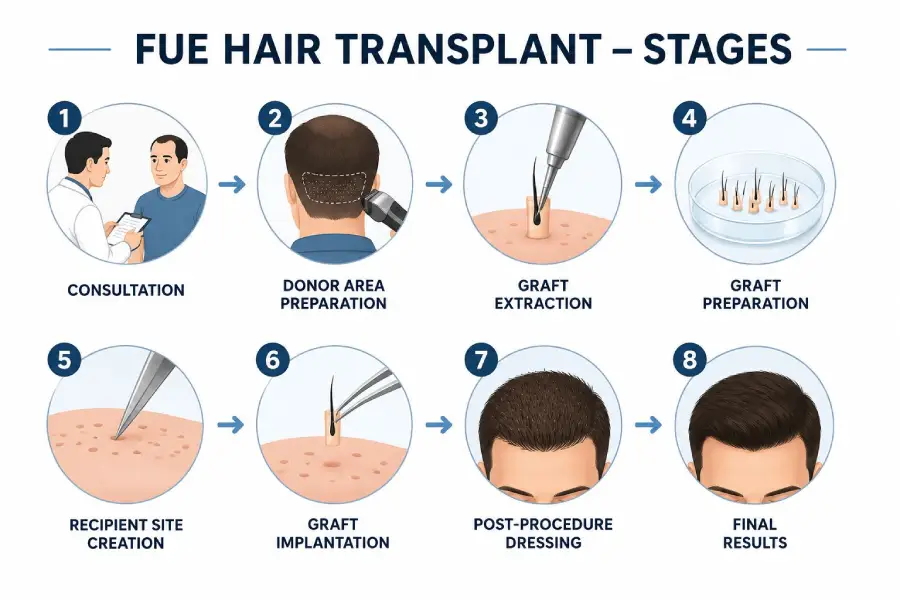
Step 1: Consultation and Hair Analysis
During consultation, I assess:
- Degree of baldness
- Donor hair quality
- Hairline design suitability
- Number of grafts required
- Long-term planning
Step 2: Designing the Hairline
Hairline design is one of the most important parts of the procedure.
I carefully consider:
- Facial proportions
- Age of the patient
- Existing hair pattern
- Natural direction of hair growth
A properly designed hairline should look natural, not only immediately after surgery but also years later.
Step 3: Donor Area Preparation
The donor area is usually located at the back and sides of the scalp.
This stage includes:
- Trimming/shaving the donor area
- Cleaning and sterilisation
- Administration of local anaesthesia
The procedure is generally comfortable because the surgery is performed under local anaesthesia.
Step 4: Graft Extraction
Individual follicular units are extracted carefully using specialised micro-punch instruments.
My Focus During Extraction
- Minimising donor area trauma
- Preserving graft quality
- Avoiding overharvesting
- Maintaining natural donor density
“During consultation, I carefully evaluate the pattern of hair loss, donor area quality, and long-term goals before recommending an FUE hair transplant plan tailored to the patient.”
Contact Details
Book Consultation: +91 98300 85506
Clinic Address: Suite 5A, Minto Park, Maruti Building, 12, Sir UN Brahmachari Sarani, opposite Bellevue Clinic, Kolkata, West Bengal 700017
Website: www.plasticsurgery-india.com
Step 5: Recipient Site Creation
Tiny recipient sites are created in the bald area while considering:
- Hair angle
- Hair direction
- Density planning
- Natural appearance
This step plays a major role in determining the final outcome.
Step 6: Implantation of Hair Grafts
The extracted grafts are implanted carefully into the prepared sites.
The goal is to achieve:
- Natural density
- Proper graft survival
- Soft and natural hairline transition
- Balanced overall appearance
Technologies Used in Modern FUE Hair Transplant
Modern FUE procedures use advanced techniques for better precision and results.
| Technology/Technique | Purpose |
| Micromotor extraction | Precise graft extraction |
| Magnification systems | Better accuracy |
| Dense packing techniques | Improved coverage |
| Advanced graft preservation | Better survival rates |
| Fine slit creation | Natural implantation angles |
Advantages of FUE Hair Transplant
FUE has become one of the most preferred hair restoration techniques because of its multiple benefits.
| Advantages | Explanation |
| Minimal scarring | No long linear scar |
| Faster healing | Smaller extraction sites heal quickly |
| Natural-looking results | Proper angulation creates realistic growth |
| Less discomfort | Minimally invasive procedure |
| Short hairstyle friendly | Tiny extraction marks are less noticeable |
| Versatile procedure | Suitable for scalp, beard, and eyebrow transplant |
Limitations of FUE Hair Transplant
Although FUE offers several benefits, patients should also understand its limitations.
Possible Limitations
- Donor area shaving may be required
- Procedure can take several hours
- Overharvesting can damage donor density if poorly performed
- Multiple sessions may be needed in advanced baldness
- Results depend heavily on surgical expertise
Proper planning is essential to achieve balanced and sustainable outcomes.
FUE Hair Transplant Recovery Timeline
Recovery after FUE hair transplant is usually gradual and predictable.
| Timeline | What to Expect |
| First 3 days | Mild swelling and redness |
| 1–2 weeks | Scab formation and healing |
| 2–6 weeks | Temporary shedding of transplanted hair |
| 3–4 months | Early hair growth begins |
| 6–9 months | Noticeable improvement in density |
| 12 months | Final results in most patients |
Post-Procedure Care
I usually advise patients to:
- Avoid strenuous exercise initially
- Follow proper hair washing instructions
- Take prescribed medications regularly
- Avoid scratching the scalp
- Attend scheduled follow-up visits
“I always advise my patients that hair transplantation is not just about immediate cosmetic improvement — it is about creating natural and sustainable results that continue to look good for years.”
Contact Details
Book Consultation: +91 98300 85506
Clinic Address: Suite 5A, Minto Park, Maruti Building, 12, Sir UN Brahmachari Sarani, opposite Bellevue Clinic, Kolkata, West Bengal 700017
Website: www.plasticsurgery-india.com
Results Expected After FUE Hair Transplant
The transplanted hair usually grows naturally because the follicles are taken from genetically resistant donor areas.
Patients Can Expect
- Improved hairline definition
- Better scalp coverage
- Natural direction of growth
- Permanent transplanted hair in most cases
- Gradual improvement over several months
However, realistic expectations are extremely important. Hair transplant surgery improves density but may not recreate the exact hair volume seen during younger years.
FUE Hair Transplant Cost in India
The cost of an FUE hair transplant in India varies depending on several factors.
Factors Affecting the Cost of FUE
- Number of grafts required
- Extent of baldness
- Surgeon’s expertise
- Clinic infrastructure
- Technology used
- Complexity of the procedure
Why Extremely Cheap Hair Transplants Can Be Risky
Very low-cost procedures may compromise:
- Graft survival
- Donor area safety
- Natural hairline design
- Sterility standards
- Long-term results
Corrective surgery after a poorly performed transplant can often become more difficult than the primary procedure itself.
FUE vs FUT Hair Transplant
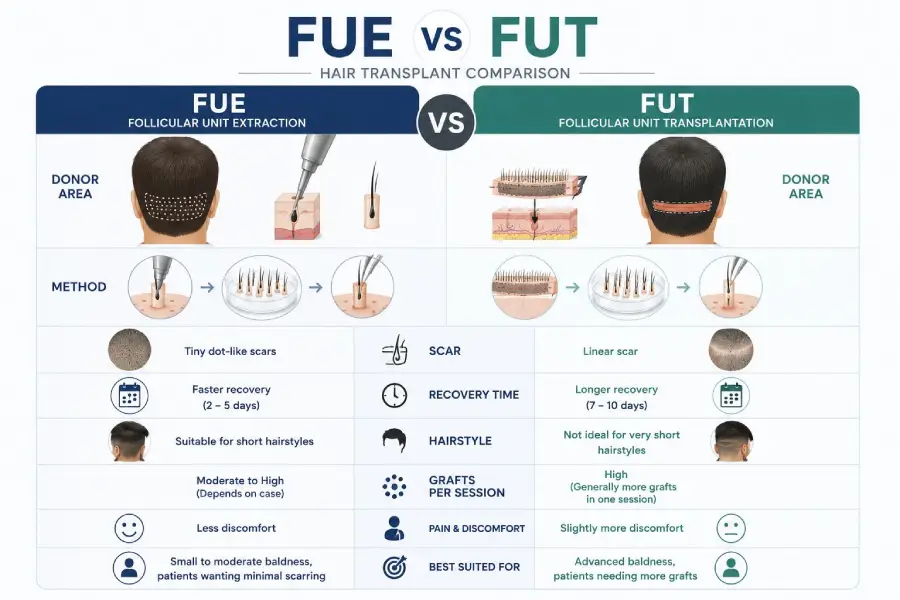
Both FUE and FUT are effective hair restoration techniques, but they differ in approach.
| Feature | FUE | FUT |
| Extraction method | Individual graft extraction | Strip harvesting |
| Linear scar | No | Yes |
| Healing | Faster in most cases | Slightly longer |
| Suitable for short hair | Yes | Less ideal |
| Large graft numbers | Moderate to high | Often better for very large sessions |
In selected patients, FUT may still be useful, especially when higher graft numbers are required and donor preservation is important.
Risks and Complications of FUE Hair Transplant
Like any surgical procedure, a FUE hair transplant also carries certain risks.
Possible Complications
- Swelling
- Temporary shock loss
- Infection (rare)
- Uneven growth
- Folliculitis
- Donor area thinning from overharvesting
Careful surgical technique and proper aftercare significantly reduce these risks.
Why Choosing an Experienced Hair Transplant Surgeon Matters
Hair transplantation combines surgical precision with artistic planning. The quality of results depends greatly on the surgeon’s experience and judgement.
Important Factors
- Natural hairline design
- Proper donor area management
- High graft survival
- Long-term planning
- Ethical graft placement
- Balanced and realistic density creation
In my practice, I focus not only on immediate cosmetic improvement but also on preserving donor hair for future requirements.
“If you are considering FUE hair transplant surgery in India, I recommend undergoing a detailed consultation to understand whether the procedure is suitable for your pattern of hair loss and long-term expectations.”
Contact Details
Book Consultation: +91 98300 85506
Clinic Address: Suite 5A, Minto Park, Maruti Building, 12, Sir UN Brahmachari Sarani, opposite Bellevue Clinic, Kolkata, West Bengal 700017
Website: www.plasticsurgery-india.com
Conclusion
FUE Hair Transplant is an advanced and effective solution for patients experiencing hair loss. When performed with proper planning and surgical precision, the procedure can provide natural-looking and long-lasting results.
However, successful outcomes depend on multiple factors, including donor area quality, realistic expectations, careful graft handling, and surgeon experience. Every patient requires an individualised treatment plan rather than a one-size-fits-all approach.
As a hair restoration surgeon, my goal is always to create results that appear natural, age appropriately, and remain aesthetically balanced over time.
FAQs
- Is an FUE hair transplant permanent?
Yes, transplanted follicles are usually permanent because they are taken from genetically resistant donor areas.
- Does FUE hair transplant leave scars?
FUE leaves tiny dot-like scars rather than a long linear scar. These are usually minimally visible after healing.
- Is FUE hair transplant painful?
The procedure is performed under local anaesthesia, so discomfort during surgery is usually minimal.
- How many grafts do I need for an FUE hair transplant?
The number of grafts depends on the extent of baldness, donor area quality, and desired density.
- What is the recovery time after an FUE hair transplant?
Most patients resume routine activities within a few days, although complete hair growth takes several months.
- When will I see results after FUE surgery?
Initial growth may begin around 3–4 months, while final results are usually seen after 10–12 months.
- Can women undergo FUE hair transplant?
Yes, selected female patients with suitable hair loss patterns may benefit from FUE hair transplant surgery.
- What is the success rate of FUE hair transplant?
Success rates are generally high when the procedure is performed by an experienced surgeon with proper technique.
- Is shaving necessary for FUE hair transplant?
In many cases, donor area shaving is required for accurate graft extraction.
- How much does an FUE hair transplant cost in India?
The cost varies depending on graft requirement, clinic infrastructure, and surgeon expertise.