Hair Transplant Cost in Kolkata – A Detailed Guide by Dr Manoj Khanna

By Dr Manoj Khanna
Board-Certified Plastic Surgeon | 30+ Years of Experience
Introduction
Hair loss is not just a cosmetic concern. In my practice, I have seen how thinning hair, receding hairlines, and bald patches can gradually affect a person’s confidence, self-image, and even social interactions. One of the most common questions patients ask me during consultation is: “What will my hair transplant cost?”
The answer is rarely the same for every patient because hair transplant pricing depends on several individual factors, including:
- Extent of baldness
- Number of grafts required
- FUE or FUT technique
- Donor hair quality
- Desired density and hairline goals
- Long-term hair restoration planning
A patient requiring minor hairline correction naturally needs fewer grafts than someone with advanced baldness involving the crown and frontal scalp.
I also advise patients not to choose a clinic based solely on the lowest price. Hair transplantation is a precision-based surgical procedure where expertise, hygiene standards, graft handling, and artistic planning directly affect the final outcome. Extremely cheap procedures may compromise graft survival, donor preservation, or natural-looking results.
In this guide, I will explain hair transplant cost transparently so you can understand what influences pricing and how to make an informed decision for long-term, natural hair restoration.
What Is the Average Cost of a Hair Transplant in Kolkata?
The average hair transplant cost in Kolkata usually ranges between INR 40,000 and INR 2,50,000 or more, depending on the extent of baldness, graft requirement, surgical technique, and the expertise of the surgeon.
Different clinics may follow different pricing structures. Some charge on a per graft basis, while others offer customised packages that may include consultation, surgery, medications, PRP therapy, and follow-up care.
Common Factors That Influence Overall Pricing
|
Factor |
Effect on Cost |
|
Number of grafts |
Higher grafts increase cost |
|
Technique used |
FUE is generally costlier than FUT |
|
Surgeon expertise |
Experienced surgeons may charge more |
|
Baldness severity |
Advanced baldness requires larger sessions |
|
Donor area quality |
Limited donor supply may increase complexity |
|
Additional treatments |
PRP and medications may add to the overall pricing |
The final cost can only be estimated accurately after a proper scalp examination and consultation. During assessment, I evaluate:
- Hair loss pattern
- Donor density
- Hair calibre
- Scalp condition
- Future progression of baldness
- Patient expectations
This personalised planning helps create a realistic and long-term treatment strategy rather than a generic one-size-fits-all approach.
Cost Range Based on Baldness Grade
|
Baldness Grade |
Approximate Requirement |
Relative Cost |
|
Mild Hair Loss |
Hairline correction or a small thinning area |
Lower |
|
Moderate Baldness |
Frontal + mid-scalp restoration |
Moderate |
|
Advanced Baldness |
Extensive frontal, mid-scalp, and crown coverage |
Higher |
Mild Hair Loss
Patients with early recession or limited thinning generally require fewer grafts and shorter procedures.
Moderate Baldness
Moderate hair loss usually requires denser coverage and a larger graft count.
Advanced Baldness
Advanced baldness often needs extensive graft harvesting, strategic donor management, and sometimes multiple sessions.
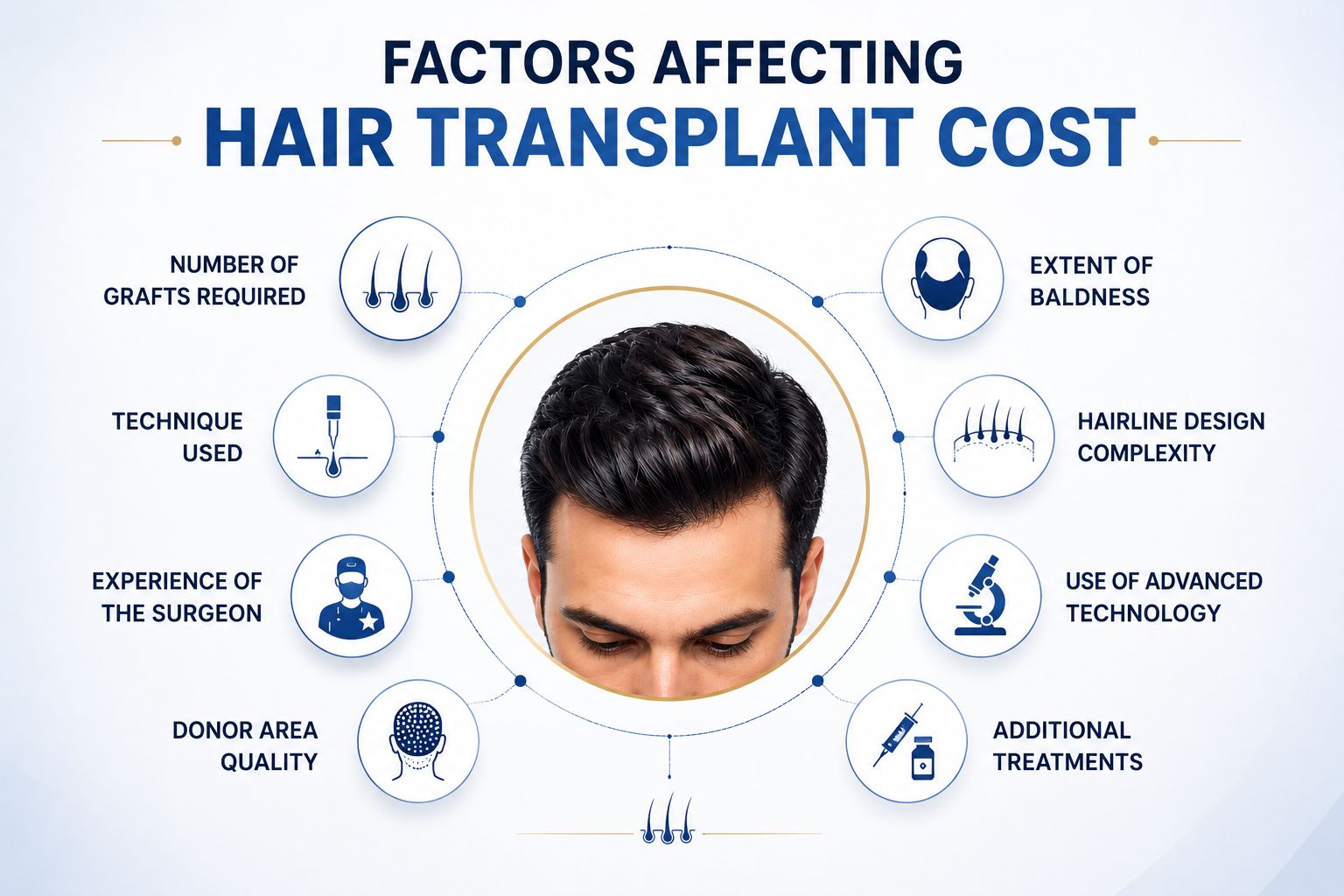
What Factors Affect Hair Transplant Cost?
Hair transplant cost varies because every patient has a unique pattern of hair loss and different restoration goals. Below are the major factors that influence the cost.
Number of Grafts Required
The number of grafts required is usually the most important factor affecting cost.
A graft is a naturally occurring follicular unit containing 1–4 hairs. Larger bald areas require more grafts and longer surgical sessions.
Approximate Graft Estimation
|
Area |
Approximate Grafts |
|
Hairline correction |
1,000–1,500 |
|
Frontal scalp |
1,500–2,500 |
|
Crown restoration |
1,500–2,500 |
|
Extensive baldness |
3,500–5,000+ |
Graft estimation depends on the following:
- Bald area size
- Desired density
- Hair texture and thickness
- Donor availability
- Long-term hair loss planning
Technique Used – FUE vs FUT
The surgical technique significantly affects cost.
|
Technique |
Characteristics |
Relative Cost |
|
FUE |
Individual follicle extraction |
Higher |
|
FUT |
Strip harvesting method |
Lower to moderate |
Why FUE Is Often More Expensive
FUE requires:
- Precision extraction tools
- More surgical time
- Individual graft harvesting
- Advanced implantation techniques
- Higher technical expertise
However, FUE is popular because it involves:
- Minimal visible scarring
- Faster recovery
- Short hairstyle compatibility
Experience of the Surgeon
Hair transplantation is not simply about implanting grafts. It requires surgical precision and artistic judgement to create a natural-looking result.
With over 30 years of experience in plastic and cosmetic surgery, I focus on:
- Natural hairline design
- Proper graft angulation
- Long-term donor preservation
- Age-appropriate planning
- Balanced density creation
An experienced surgeon helps minimise the risk of:
- Unnatural hairlines
- Poor density
- Donor overharvesting
- Visible scarring
Donor Area Quality
The donor area is the foundation of a successful hair transplant.
Good Donor Areas Usually Have:
- Higher hair density
- Thick hair shafts
- Stable follicles
- Better scalp flexibility
Limited Donor Areas May Require:
- Conservative planning
- Combination techniques
- Lower density expectations
- Multiple sessions
Extent of Baldness
The severity of hair loss is commonly evaluated using the Norwood Scale.
|
Norwood Grade |
Hair Loss Severity |
Impact on Cost |
|
Grade 2–3 |
Mild recession |
Lower |
|
Grade 4–5 |
Moderate baldness |
Moderate |
|
Grade 6–7 |
Extensive baldness |
Higher |
Advanced grades require:
- More grafts
- Larger operative sessions
- Careful donor management
Hairline Design Complexity
Creating a natural hairline is one of the most artistic parts of hair transplantation.
Factors considered include:
- Facial proportions
- Age
- Ethnicity
- Existing hair pattern
- Future hair loss progression
Complex hairline refinement may require:
- Single-hair graft placement
- Higher precision
- Additional operative time
Use of Advanced Technology
Modern hair transplantation uses advanced tools and magnification systems to improve graft survival and minimise trauma. These may include:
- Microscopic graft dissection
- Precision punches
- Advanced implantation devices
- Magnification systems
- Refined graft storage methods
Better technology often improves accuracy, healing, density, and overall results.
Additional Treatments
Some patients benefit from combination therapies that may increase the overall treatment cost.
Common Add-On Treatments
|
Treatment |
Purpose |
|
PRP Therapy |
Improve healing and hair quality |
|
Medications |
Slow ongoing hair loss |
|
Combination therapies |
Improve density and maintenance |
These treatments may help optimise long-term hair preservation and enhance overall outcomes.
Hair Transplant Cost Per Graft – How Is It Calculated?
Many clinics calculate hair transplant pricing based on the number of grafts required. A graft is a naturally occurring group of hair follicles extracted from the donor area and implanted into thinning or bald regions.
On average:
- One graft contains approximately 1–4 hairs
- Most grafts contain around 1.5–2 hairs
The number of grafts required varies from one patient to another because every scalp has different:
- Baldness patterns
- Hair density
- Hair thickness
- Donor supply
- Cosmetic goals
For example, a patient requiring only frontal hairline correction may need far fewer grafts than someone seeking complete scalp restoration.
How Clinics Usually Charge
|
Pricing Model |
Description |
|
Per Graft Pricing |
Cost calculated according to graft count |
|
Package Pricing |
Fixed package for a graft range or procedure |
During consultation, I assess:
- Scalp condition
- Hair characteristics
- Donor density
- Bald area size
- Future hair loss progression
This helps create a personalised treatment plan aimed at achieving natural and long-lasting results.
Approximate Graft Requirements
|
Treatment Area |
Approximate Grafts Needed |
|
Frontal Hairline |
1,000–2,000 |
|
Crown Area |
1,500–2,500 |
|
Full Scalp Restoration |
3,500–5,000+ |
Frontal Hairline
Hairline correction usually requires fewer grafts but demands high artistic precision for naturalness.
Crown
The crown often needs more grafts because of its circular growth pattern and larger coverage area.
Full Scalp Restoration
Advanced baldness involving the frontal scalp, mid-scalp, and crown may require extensive graft sessions and staged treatment planning.
FUE Hair Transplant Cost
Follicular Unit Extraction (FUE) is one of the most popular modern hair transplant techniques used today. In FUE, individual follicular units are extracted directly from the donor area using specialised micro-punch instruments and then implanted into the balding regions.
FUE has become widely preferred because it offers:
- Minimal visible scarring
- Faster healing
- Reduced postoperative discomfort
- Natural-looking results
- Compatibility with shorter hairstyles
However, FUE is generally more expensive than FUT because the procedure is highly detail-oriented and time-intensive.
Factors That Influence FUE Hair Transplant Cost
|
Factor |
Impact on Cost |
|
Number of grafts |
Larger sessions increase cost |
|
Extent of baldness |
Advanced cases require more grafts |
|
Surgeon expertise |
Precision and naturalness matter |
|
Donor quality |
Difficult extraction may increase complexity |
|
Technology used |
Advanced tools improve precision |
FUE requires meticulous extraction and implantation techniques to minimise trauma and maximise graft survival. Every follicle must be handled carefully to preserve healthy growth.
Best Suited Candidates for FUE
FUE may be suitable for:
- Patients preferring short hairstyles
- Individuals with mild to moderate baldness
- Patients concerned about visible scarring
- People seeking a faster recovery
- Beard and eyebrow transplant candidates
When performed properly, FUE can provide highly natural and long-lasting hair restoration with minimal donor area visibility.
FUT Hair Transplant Cost
Follicular Unit Transplantation (FUT), also known as the strip method, involves removing a thin strip of scalp from the donor area, after which follicular grafts are dissected under magnification and implanted into the recipient area.
Although FUE is currently more popular, FUT still remains beneficial in selected cases.
Why Some Patients May Benefit from FUT
FUT may be useful for:
- Patients requiring a large number of grafts
- Individuals with extensive baldness
- Patients with strong scalp laxity
- Cases where donor preservation is important
Compared to FUE, FUT is often relatively more cost-effective because graft harvesting can sometimes be performed more efficiently in larger sessions.
FUT vs FUE Cost Comparison
|
Technique |
Relative Cost |
Scarring |
|
FUT |
Lower to Moderate |
Linear scar |
|
FUE |
Moderate to Higher |
Tiny dot scars |
The main concern with FUT is the linear scar at the donor site. However, when performed carefully and closed properly, the scar is often concealed beneath surrounding hair in most patients.
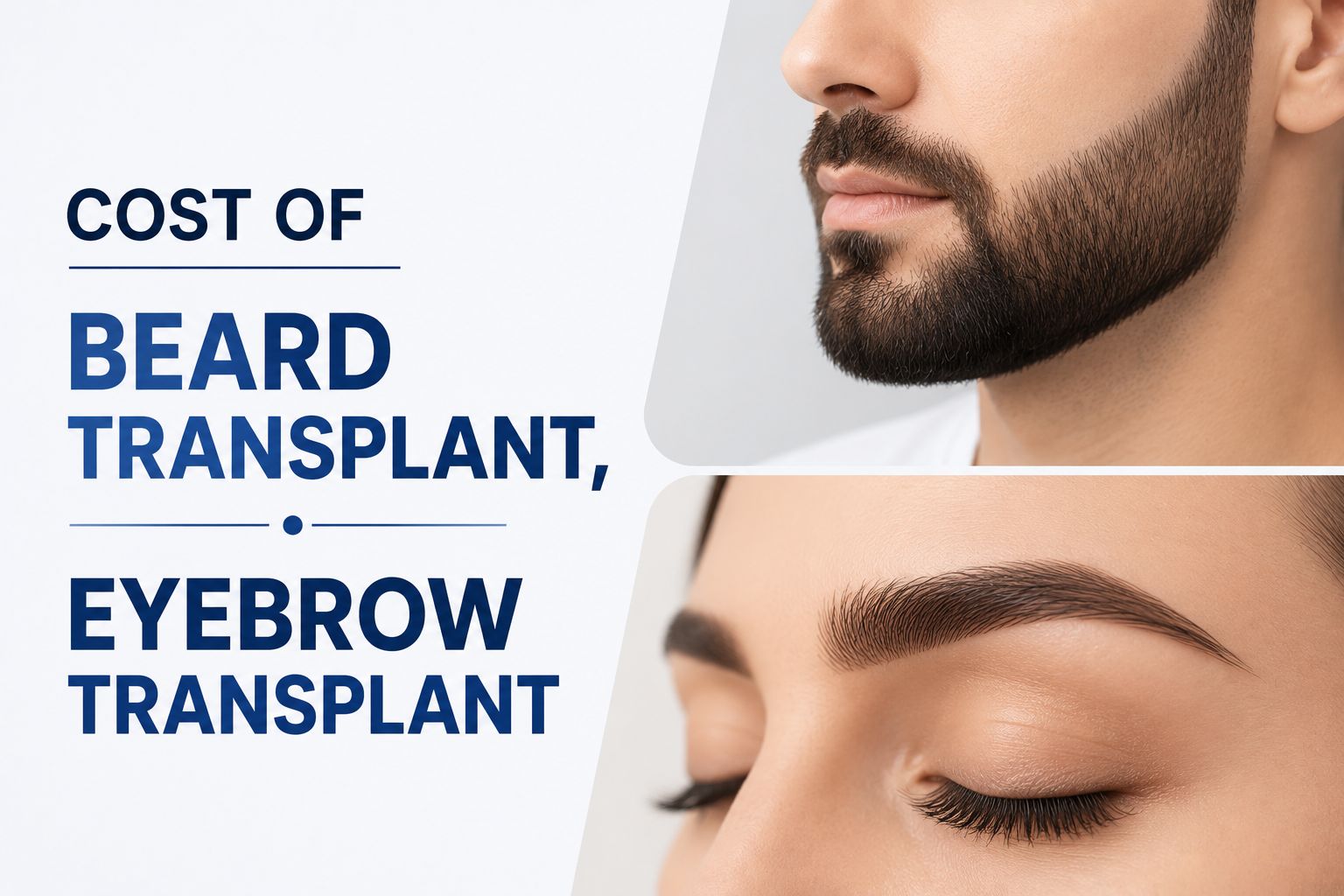
Cost of Beard Transplant, Eyebrow Transplant & Other Hair Restoration Procedures
Hair restoration is not limited to the scalp alone. Many patients also seek improvement in beard density, eyebrow shape, or hairline positioning for aesthetic enhancement.
Although these procedures may require fewer grafts than scalp transplantation, they often demand greater precision, artistic planning, and meticulous graft placement.
Beard Transplant Cost
Beard transplantation is commonly performed for:
- Patchy beard growth
- Sparse moustache areas
- Beard asymmetry
- Scar camouflage
Approximate Beard Transplant Requirements
|
Area |
Approximate Grafts |
|
Moustache |
300–800 |
|
Partial beard filling |
800–1,500 |
|
Full beard transplant |
2,000–3,500 |
Beard transplantation requires careful attention to:
- Facial symmetry
- Hair direction
- Natural beard density
- Proper angulation
Eyebrow Transplant Cost
Eyebrow transplantation is one of the most precision-sensitive hair restoration procedures.
Patients may seek eyebrow restoration because of:
- Overplucking
- Naturally thin eyebrows
- Scarring
- Medical hair loss conditions
Since eyebrow hair grows at very specific angles, graft placement requires extremely fine detailing to create natural-looking results.
Hairline Lowering / Density Correction Cost
Hairline-lowering and density correction procedures are designed for:
- Broad foreheads
- Weak frontal density
- Previous transplant correction
- Refinement of existing hairlines
These procedures may involve fewer grafts but often require:
- Advanced artistic planning
- Dense packing techniques
- High precision implantation
- Careful facial proportion analysis
Schedule a Personal Hair Assessment
Every patient experiences hair loss differently. The ideal treatment plan depends on your scalp condition, donor density, future hair loss pattern, and aesthetic goals.
A proper consultation helps determine:
- Approximate graft requirement
- Suitable technique (FUE or FUT)
- Donor area capacity
- Expected density and coverage
- Long-term treatment planning
With personalised assessment and surgical planning, I aim to create natural-looking and sustainable hair restoration results tailored to each individual.
Contact Details
Book Consultation: +91 98300 85506
Clinic Address: Enhance Aesthetic and Cosmetic Studio, 12, Loudon Street, Flat 5A, Kolkata, West Bengal 700017, Opposite Bellevue Clinic
Website: www.plasticsurgery-india.com
Why Extremely Cheap Hair Transplants Can Be Risky
Hair transplantation should never be chosen purely based on the lowest advertised price. Extremely cheap procedures may sometimes compromise surgical quality, safety standards, and long-term results.
Common Risks Associated with Low-Cost Hair Transplants
|
Risk |
Possible Consequence |
|
Overharvesting |
Permanent donor area thinning |
|
Unnatural hairlines |
Artificial appearance |
|
Poor graft survival |
Low-density growth |
|
Infections |
Scalp complications |
|
Technician-driven surgery |
Reduced surgical precision |
|
Inadequate planning |
Wasted donor grafts |
Overharvesting of the Donor Area
Excessive graft extraction without proper planning can permanently damage the donor region, creating visible thinning and patchiness.
Unnatural Hairline Design
Poorly designed hairlines may appear too straight, dense, or age-inappropriate, making the transplant look artificial.
Poor Graft Survival
Improper handling, dehydration of grafts, and rushed implantation techniques can significantly reduce hair growth after surgery.
Infection and Safety Concerns
Low-cost setups may compromise:
- Sterilisation standards
- Surgical supervision
- Quality control
- Patient safety protocols
Technician-Driven Procedures
In some clinics, major parts of the surgery may be performed primarily by technicians rather than experienced surgeons. Hair transplantation requires medical judgement, precision, and artistic planning that should remain under expert supervision.
Revision Surgery Can Become More Expensive
Correcting a poorly performed transplant is often more difficult and expensive than performing a proper primary surgery. In many cases, donor hair availability also becomes limited after unsuccessful procedures.
For this reason, I always encourage patients to prioritise:
- Surgical expertise
- Ethical treatment planning
- Safety standards
- Natural-looking outcomes
- Long-term donor preservation
A carefully planned hair transplant is an investment in both appearance and long-term confidence.
Is Hair Transplant Worth the Cost?
For many patients, a hair transplant is not simply a cosmetic expense — it is a long-term investment in confidence, appearance, and quality of life. Unlike temporary solutions that require continuous maintenance, a properly performed hair transplant offers long-lasting and often permanent results using your own natural hair follicles.
Transplanted hair is usually taken from genetically stable donor areas that are resistant to pattern baldness. Once the grafts heal and grow successfully, they continue to behave like normal hair in their new location.
Why Many Patients Consider Hair Transplant Worthwhile
|
Benefit |
Long-Term Value |
|
Permanent hair growth |
Reduces dependence on temporary solutions |
|
Natural appearance |
Improves facial framing and aesthetics |
|
Better confidence |
Positive psychological impact |
|
Low long-term maintenance |
No repeated concealment treatments |
|
Personalised restoration |
Tailored to individual goals |
Many patients spend years repeatedly investing in:
- Hair fibres
- Concealers
- Wigs or patches
- Temporary salon treatments
- Repeated PRP sessions without restoration
While some non-surgical treatments may help slow hair loss, they often require ongoing maintenance costs. In contrast, surgical restoration aims to create a more stable and lasting improvement when performed appropriately.
Beyond appearance, patients frequently report improvements in:
- Self-confidence
- Social comfort
- Professional confidence
- Overall self-image
For suitable candidates, a carefully planned hair transplant can provide both aesthetic and psychological benefits that extend far beyond the procedure itself.
How I Plan Hair Transplants for Natural and Cost-Effective Results
In my approach to hair transplantation, I believe that successful results are achieved not by using the maximum number of grafts, but by using grafts intelligently and responsibly. Every patient has a limited donor supply, and preserving that donor area is one of the most important aspects of long-term hair restoration planning.
I carefully assess:
- Current hair loss pattern
- Future risk of progression
- Donor density and quality
- Facial proportions
- Desired coverage and density
My goal is always to create results that appear natural, not only today, but also years later as the patient ages.
Principles I Follow During Hair Transplant Planning
|
Principle |
Purpose |
|
Conservative donor management |
Preserve grafts for future needs |
|
Natural hairline design |
Avoid artificial appearance |
|
Long-term planning |
Ensure age-appropriate results |
|
Controlled graft usage |
Prevent unnecessary harvesting |
|
Precision implantation |
Improve density and survival |
I avoid aggressive or overly dense hairlines that may look unnatural over time or consume excessive grafts unnecessarily. Instead, I focus on balanced density and realistic planning suited to the patient’s long-term hair pattern.
Every stage of the procedure is personally supervised with attention to:
- Graft handling
- Hairline artistry
- Implantation angle
- Donor preservation
- Surgical precision
My aim is to provide safe, ethical, and aesthetically refined hair restoration while making the best possible use of each patient’s donor hair.
Conclusion
Hair transplant cost should never be evaluated based only on numbers. The quality of surgical planning, the experience of the surgeon, donor preservation, safety standards, and the naturalness of the final result are equally important factors when making a decision.
Every patient’s hair loss pattern is different, which is why personalised consultation and long-term planning are essential. A carefully designed procedure can help achieve natural-looking results while preserving donor hair responsibly for the future.
In my practice, I focus on:
- Ethical treatment planning
- Conservative donor management
- Natural hairline creation
- Precision-based surgery
- Long-term aesthetic outcomes
Whether you are considering a small hairline correction or extensive scalp restoration, the right approach begins with a detailed assessment and realistic expectations.
Schedule a Consultation
Considering Hair Transplant in Kolkata?
Consult Dr Manoj Khanna, a board-certified plastic and cosmetic surgeon with over 30 years of experience in aesthetic and reconstructive surgery. At Enhance Aesthetic and Cosmetic Studio, Kolkata, patients receive advanced, safe, and personalised treatment plans designed to achieve natural-looking results with patient safety as a priority.
Whether you are travelling from Kolkata, elsewhere in India, or internationally, online and WhatsApp consultations are available.
Contact Details
Book Consultation: +91 98300 85506
Clinic Address: Enhance Aesthetic and Cosmetic Studio, 12, Loudon Street, Flat 5A, Kolkata, West Bengal 700017, Opposite Bellevue Clinic
Website: www.plasticsurgery-india.com
Hair Transplant Cost FAQs
- How much does a hair transplant cost in Kolkata?
Hair transplant cost in Kolkata may range from approximately ?40,000 to ?2,50,000 or more, depending on graft requirement, technique, and surgical complexity.
- What is the cost per graft for a hair transplant?
Many clinics charge on a per-graft basis, although pricing varies according to surgeon expertise, technology, and treatment planning.
- Is FUE more expensive than FUT?
Yes, FUE is generally more expensive because it involves individual follicle extraction and requires greater precision and operative time.
- How many grafts will I need?
The required graft count depends on your baldness grade, desired density, donor capacity, and treatment goals.
- Does a hair transplant cost include medicines?
This depends on the clinic. Some packages include medications and postoperative care, while others charge separately.
- Is PRP included in the package?
Certain clinics may include PRP sessions within comprehensive treatment packages, while others offer them as optional add-on procedures.
- Can the cost increase after surgery?
Additional costs may arise if further sessions, medications, or supportive treatments become necessary later.
- Are cheaper hair transplants safe?
Very low-cost procedures may compromise surgical quality, donor preservation, hygiene standards, and long-term results.
- Is a hair transplant permanent?
In most cases, transplanted follicles are permanent because they are taken from genetically stable donor areas.
- Can I pay in instalments?
Some clinics may offer EMI or instalment facilities depending on the treatment plan and payment policies.
- Does a beard transplant cost less than a scalp transplant?
Beard transplantation often requires fewer grafts than scalp restoration, although precision and detailing can still influence pricing.
- Will I need a second session later?
Some patients with progressive hair loss or extensive baldness may require additional sessions in the future for maintenance or increased coverage.
Enhance Aesthetic & Cosmetic Studio
12, Loudon Street Kolkata - 700 017, India
Monday to Saturday at - 10am to 7pm (By appointment)
+91-33-22829126 / 22828500
+91 98300 85506
drmkhanna@gmail.com
Celebrities with Dr Manoj Khanna
• Arun Lal, Cricket Player
• Dilip Vengsarkar, Cricket Player
• Brijesh Patel, Cricket Player
• Roger Binny, Cricket Player
• Govinda, Actor
• Mimoh Chakrabarty, Actor
• Arjun Chakrabarty, Actor
• Nikhil Chopra, Cricket Player
• Charu Sharma, Cricket Player
• Rituparna Sengupta, Actor
• Lalchand Rajput, Cricket Player
• Brijesh Patel, Cricket Player