
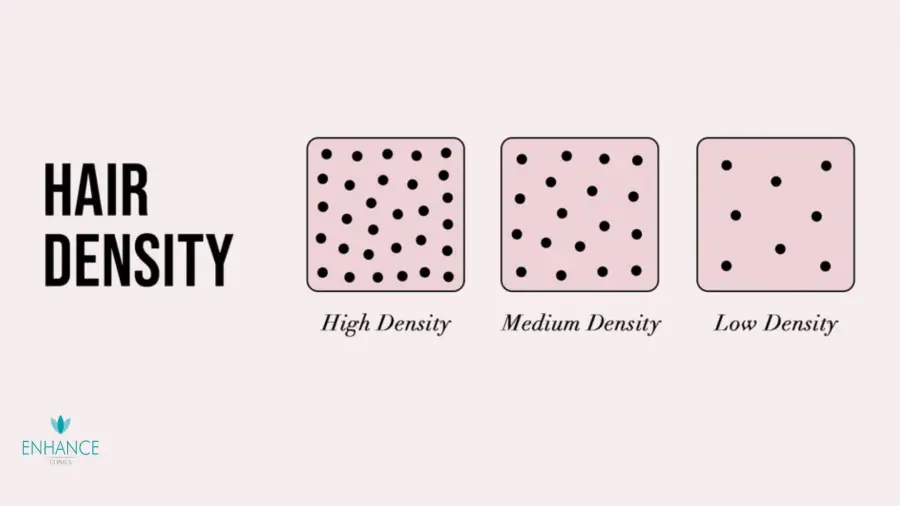
When it comes to a successful hair transplant, density is one of the most important factors determining how natural and aesthetically pleasing your results appear.
Even if the transplanted hair grows well, an uneven or low-density can make the result look “transplanted” instead of natural.
So, what exactly does density mean in hair transplantation — and how do skilled surgeons achieve it?
Understanding Hair Density
Hair density refers to the number of hair grafts transplanted per square centimetre (cm²) of the scalp.
In a natural head of hair, this density usually ranges between 70–100 follicular units per cm². During a hair transplant, surgeons aim to recreate this density in a way that appears natural while also ensuring long-term graft survival.
However, it’s not just about placing more grafts. True density depends on the strategic distribution of follicles, angle and direction of placement, and type of hair used.
Why Density Is So Important
A well-executed hair transplant is defined not only by hair growth but also by how naturally it blends with existing hair.
Proper density ensures:
- Natural appearance: Fuller coverage hides scalp visibility.
- Balanced proportions: Hairline looks realistic, not artificial.
- Confidence booster: Denser results look thicker, improving self-esteem.
Without sufficient density, even a successful transplant looks thin or scanty.
Factors Affecting Hair Transplant Density
- Donor Area Quality:
The number of healthy grafts available at the back of the scalp determines how many grafts are available, thereby determining how dense the transplanted area can be. - Graft Survival Rate:
Density depends on how many grafts successfully grow after the procedure. Skilled handling and precise placement ensure higher survival. - Surgical Technique:
Techniques like FUE (Follicular Unit Extraction) and FUT (Strip Method) allow dense packing when performed by experienced, skilled hands. - Hair Characteristics:
Thicker, curly, or darker hair provides an illusion of more density than fine or straight hair. - Recipient Area Condition:
Scarred or previously operated scalps may limit how closely grafts can be placed.
How Surgeons Achieve Natural-Looking Density
Achieving the perfect balance between density and safety requires expertise. Here’s how top surgeons like Dr. Manoj Khanna approach it:
- Customised Density Planning: Each patient’s donor capacity and bald area are analysed to set a realistic graft number.
- Zonal Distribution: Higher density is achieved at the front (hairline and frontal zone), gradually reducing toward the crown for a natural gradient.
- Microscopic Graft Placement: Fine instruments allow dense packing — up to 40–50 grafts per cm² safely.
- Proper Angulation: Each graft is inserted at the correct direction and angle to mimic natural hair growth.
Can You Increase Density After a Hair Transplant?
Yes — secondary or touch-up sessions can be performed to enhance density once the first transplant has fully grown (usually after 9–12 months).
This is especially common in patients with limited donor hair during the first session or when larger bald areas are covered gradually.
Proper maintenance — such as PRP therapy, good nutrition, and avoiding smoking — also helps maintain healthy graft growth and visual thickness.
Common Myths About Density
Myth 1: More grafts always mean more density.
âž¡ï¸ Not true — overcrowding grafts can reduce blood supply and affect survival. Balance is key.
Myth 2: High-density transplants damage existing hair.
âž¡ï¸ With careful technique, dense packing can safely coexist with native hair.
Myth 3: Density is only about numbers.
âž¡ï¸ Hair thickness, colour contrast, and styling pattern all play a role in visual fullness.
Conclusion
Hair density is the heart of a natural-looking hair transplant. It’s not just about numbers — it’s about technique, planning, and artistry.
With precise execution, experienced guidance, and realistic expectations, patients can achieve dense, youthful results that look and feel completely natural.
If you’re considering a hair transplant, consult Dr. Manoj Khanna, one of India’s leading hair restoration experts, to design a customised treatment plan that delivers natural density and long-lasting results.
Frequently Asked Questions
1. What is the ideal density for a hair transplant?
Usually, 35–50 follicular units per cm² is sufficient for a natural look, depending on donor supply and hair type.
2. Can 100% natural density be achieved?
Not always — the goal is to create the illusion of fullness while ensuring healthy graft survival.
3. How soon will I see full density?
Visible density develops gradually over 8–12 months as transplanted hair grows in cycles.
4. Can PRP or medications improve density after transplant?
Yes, PRP therapy, minoxidil, and finasteride can support growth and thickness post-surgery.